Homeowners' pick for appliance repair across Texas
Microwave Repair — Book a Visit Today
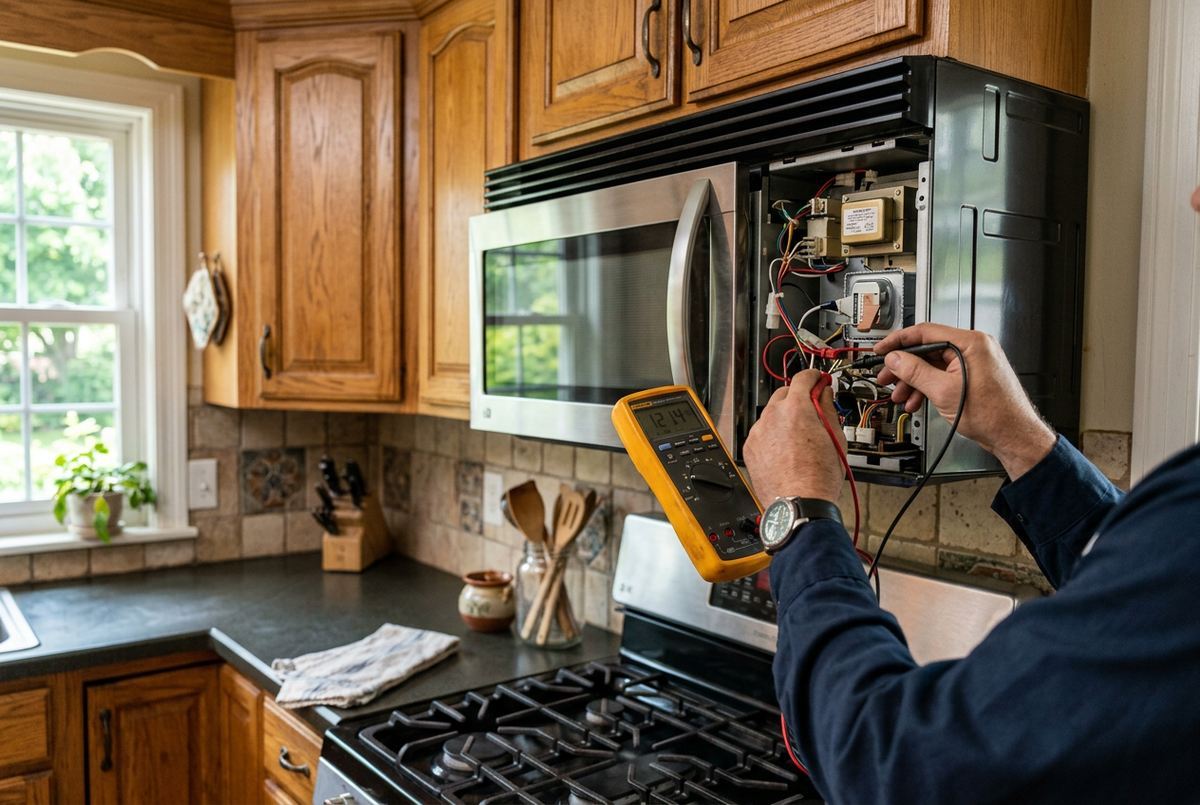
We repair microwaves anywhere in Texas, and most of them fail in a handful of predictable ways. The magnetron gives out, so the plate spins while nothing heats. A door switch fails and the unit plays dead. Control boards get flaky after a power blip, and over-the-range models cook their own fan motors once grease builds up. On a visit we open the cabinet, discharge the high-voltage capacitor, then test the switches, diode, and board in order. After that we tell you plainly what part failed and whether repair makes sense for that unit. Built-in and drawer models are usually worth fixing. Countertop units, sometimes not. We're an independent shop and we work on all major brands. Call us and describe what it's doing.
Call (888) 857-9883- A real person answers
- Open 7 days
- Written quote before work starts
Taking calls until 5:00 PM CT
The microwave symptoms we hear most
- Runs but my food stays cold Magnetron, high-voltage diode, or capacitor failure
- Nothing happens when I press start Door interlock switches, thermal fuse, or line fuse
- Loud buzzing when it's cooking Failing magnetron or a shorted high-voltage transformer
- Turntable sits still the whole cycle Turntable motor, drive coupler, or stripped support roller
- Vent fan roars and won't shut off Grease-clogged blower, bad relay, or stuck touchpad
Safe things to check first
Worth a look before you call — sometimes it saves you the visit.
- 1Plug a lamp or phone charger into the outlet to be sure it has power.
- 2Push the door until it clicks all the way shut, then try a 30-second cycle.
- 3See if a GFCI outlet or the kitchen breaker tripped, and reset it once.
- 4On an over-the-range unit, pull the charcoal or grease filter and look for it caked shut.
Guides & troubleshooting
What homeowners get from an independent shop
| Appliance Tech | Big-box repair chains | Handyman listings | |
|---|---|---|---|
| Written quote before any work | ✓ | ✕ | ✕ |
| Live answer seven days a week | ✓ | ✕ | ✓ |
| All major brands, gas and electric | ✓ | ✓ | ✕ |
| Independent, no manufacturer quotas | ✓ | ✕ | ✓ |
| Crews familiar with homes like yours | ✓ | ✕ | ✓ |
What homeowners say after the visit
“The tech double-checked gas connections before leaving even though the job was electric. Careful people.”
Lois W.El Paso, TX“From first call to spinning drum, under 30 hours. Everything in writing.”
Cole R.Plano, TX“They serviced the rental across town and sent photos of the finished repair. Perfect for a landlord.”
Meg A.Garland, TXMicrowave Repair — quick answers
Is a microwave that won't heat worth repairing?
Often yes on built-in, drawer, and over-the-range units, because replacing those means cabinet work. We test the high-voltage side first and tell you which part failed. If the repair doesn't make sense for that unit, we say so.
Why shouldn't I open it myself?
The capacitor inside holds a dangerous charge even unplugged, sometimes for a long while. We discharge it before we touch anything else. That one step is why microwave work belongs to someone with the right tools and habits.
Can you fix a microwave built into cabinets?
Yes. We pull built-ins and trim-kit models out carefully, work on the bench or in place, then reset them square so the door seals right. Over-the-range units come down the same way, with support for the weight.
My touchpad only responds to some buttons. What's wrong?
Usually the membrane behind the panel has worn through, or the control board lost a trace. We test the pad and the board separately so you don't pay for the wrong part. On older units both sometimes go at once.
Does hard water hurt a microwave?
Not directly. Scale and mineral film do build on the interior and around the door gasket in a lot of Texas homes, and that grit keeps the door from seating, which stresses the interlock switches. Wiping the frame regularly helps.
What should I tell you when I call?
Brand, roughly how old it is, whether it's countertop or installed, and exactly what it does. Sparks, a burning smell, no display, heats-then-stops: those all point different directions. Details on the phone mean the right parts on the truck.
How it works
- Step 1
Tell us the symptom
Call us or fill out the form and describe what you hear, smell, or see. A noise, a leak, an error code, a burning odor. Give us the brand and rough age if you know them.
- Step 2
We come look
A technician shows up with common parts on the truck. We test the machine instead of guessing. Then we explain what failed in plain words, and what the repair takes, before anything gets opened up.
- Step 3
You decide, we repair
Nothing gets replaced without your go-ahead. Most repairs finish the same visit. If a part has to be ordered, we tell you straight and set a return time that works for your day.
- A real person answers
- Open 7 days
- Written quote before work starts
Why homeowners call us
- Hard water is our specialtyWest Texas scale wrecks dishwashers, ice makers, and water valves, and we see it daily. Spray arms clog. Heating elements crust over and inlet screens choke up white. We clean and replace the parts scale eats first.
- Built for Texas summersHeat pushes refrigerators and freezers hard. Condenser coils pack with dust, compressors run nonstop, and garage freezers quit in triple digits. We check cooling systems for heat load, not just for the obvious broken part.
- Plain talk, no runaroundWe tell you what died and why. If a machine is not worth fixing, we say so. You get the reasoning instead of a sales pitch, and you make the call yourself.
- Most brands, most machinesWashers, dryers, ranges, ovens, dishwashers, fridges, freezers. We work as an independent shop on all major brands, top load and front load, gas and electric. One call covers the laundry room and the kitchen.
- All major brands, gas & electricEvery major appliance brand, gas and electric, handled by an independent shop.
- Straight answersWhen a repair doesn't make sense, we tell you, sometimes before we even roll a truck.
Microwave Repair
Small faults become big ones on a schedule of their own
Describe the symptoms and we'll book the visit — takes about a minute.
- A real person answers
- Open 7 days
- Written quotes
- All major brands
- Gas & electric
Rather not call? Get a free quote →